Try The Tool
Check whether a BER improvement is worth exploring
Use the BER calculator while you read to sense-check whether a move to a stronger rating could support your sale before spending on works or reassessment.
Ireland's residential BER scale is changing from 24 May 2026. The key point for sellers is reassuring: the rules on needing a BER for sale or rent are not changing, and existing BER certificates remain valid for 10 years unless major renovation works have changed the home's energy performance.
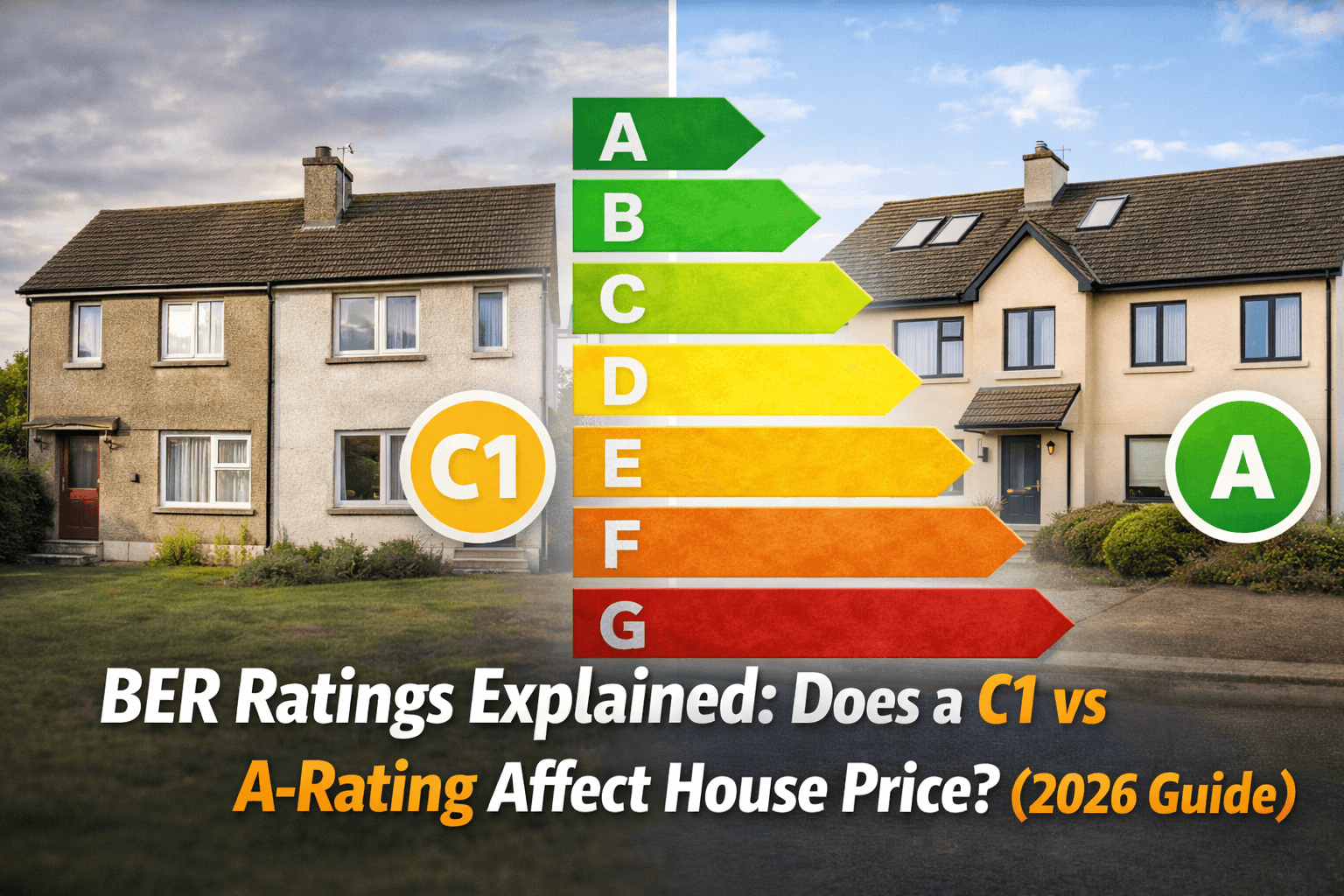
What is changing is the way new BER certificates are displayed. SEAI says the current detailed scale with sub-categories such as B1, B2 and B3 will move to a simpler set of categories: A0, A, B, C, D, E, F and G.
This guide explains what that means in plain English, when you may need a fresh certificate, and how to think about BER before selling, renting, or choosing upgrade work.
Quick answer: what is changing from 24 May 2026?
According to SEAI's new simplified BER scale guidance, the residential BER scale will be simplified from 15 rating levels to 8 categories.
| Before 24 May 2026 | From 24 May 2026 | What it means |
|---|---|---|
| A1, A2, A3 | A0 or A | A0 is a new top category for highly efficient homes that do not use fossil fuels; other A-rated homes sit in the broader A category. |
| B1, B2, B3 | B | The old B sub-categories are removed on new certificates. |
| C1, C2, C3 | C | The old C sub-categories are removed on new certificates. |
| D1, D2, E1, E2, F, G | D, E, F, G | The scale becomes easier to read, with fewer labels for buyers, tenants and homeowners to compare. |
The change is mainly about clarity. A BER will still describe the energy performance of the home, but buyers and tenants will see a simpler label on new residential BER certificates.
Will my existing BER still be valid if I am selling?
Yes, in most cases. SEAI says existing BER certificates remain valid for 10 years from their date of issue. They can still be used for mandatory requirements such as sale, rental and rental contract renewal, unless major renovations have taken place that could alter the dwelling's energy performance.
So if you already have a valid BER and you have not carried out major energy-impacting works, the new scale does not automatically force you to get a fresh certificate before listing.
If the BER has expired, or if works such as a new extension, heating system, insulation package or other major upgrade have changed the energy performance, then you should plan for a new assessment.
Do sellers still need a BER before advertising?
Yes. The requirement itself has not gone away. SEAI's BER register guidance says a BER certificate is compulsory for homes available for sale or rent.
In seller terms, treat BER as part of launch preparation rather than a last-minute legal formality. You want the rating, BER number and supporting paperwork ready before the property is advertised, especially if the home has had energy upgrades that you want buyers to notice.
What is A0?
A0 is the new top residential BER category. SEAI describes it as a category for the most energy-efficient homes that do not use fossil fuels.
For many sellers, A0 will be less relevant than the simpler shift from detailed labels like B3 or C1 into broader B and C categories. But for new-builds, deep retrofits and very high-performance homes, A0 gives a clearer top-end signal.
What new information appears on the BER certificate?
SEAI says the updated certificate will display the simplified scale and add more information for homeowners, buyers and tenants, including:
- energy use
- renewable energy contribution
- whole-life carbon emissions information, measured as Global Warming Potential
- a QR code linking to BER details and tailored home-upgrade information
That extra context matters because buyers increasingly ask not just "what is the letter?" but also "what would it take to improve this home?".
Should I wait until after 24 May 2026 to get a new BER?
For most sellers, the better question is not the date itself. It is whether the certificate you have is accurate, valid and useful for the sale.
- If you have a valid BER and no major energy works since it was issued: you usually do not need a fresh BER just because the scale is changing.
- If your BER is expired: book a new assessment before advertising the property.
- If you have completed upgrades: gather the evidence and consider whether a fresh BER would better reflect the home.
- If you are actively listing around the changeover date: ask your estate agent and BER assessor what timing is most practical for your launch.
If you think the current BER does not reflect work already done, read BER Not Reflecting Upgrades? before booking anything.
What does this mean for B3 and green-mortgage language?
The old B3 label has been important in seller conversations because some buyers associate B3 or better with stronger efficiency and possible green-mortgage eligibility. Once new certificates use broader categories, that language may become less straightforward.
Do not assume that every bank, broker or buyer will interpret the new B label in exactly the same way. Mortgage product criteria can differ and may update, so if green-mortgage eligibility is part of your selling story, check the current lender rules rather than relying on old shorthand.
For now, sellers should keep the practical message simple: a stronger BER can still help buyer confidence, but it is only one part of pricing, presentation and agent strategy.
How sellers should use the new BER scale
The simplified scale may make listings easier for buyers to scan, but it also means sellers should be ready to explain the story behind the rating.
- Keep the BER certificate and advisory report with your selling documents.
- Keep evidence for upgrades such as insulation, windows, heating, controls and renewables.
- Ask your agent how BER will be presented in the listing copy and viewings.
- Use the advisory report to identify whether any affordable pre-sale upgrades are worth considering.
- Compare likely upgrade benefit with the cost, delay and wider selling budget.
If you are early in the preparation stage, this also pairs well with Documents Needed to Sell a House in Ireland and How BER Can Affect Sale Value.
What landlords should know
Landlords should also pay attention because BER is relevant to rental advertising and to how tenants compare comfort and likely running costs.
The new scale does not remove the need for a BER when a property is offered for rent. Existing valid BERs can still be used unless major renovations have changed the energy performance. If you are preparing a rental for a new tenancy, it is worth checking the BER status early rather than discovering an expired certificate at listing time.
If you are deciding between renting and selling, use the BER question alongside the wider numbers: expected rent, upgrade cost, letting fees, management cost and possible sale proceeds.
Should I upgrade before selling because of the new scale?
The new scale alone is not a reason to rush into expensive works. The commercial question is still the same: will the upgrade make the property easier to sell, easier to price, or more attractive to the right buyers?
A sensible approach is:
- Check whether your current BER is valid.
- Review the advisory report and any upgrade recommendations.
- Gather evidence for works already completed.
- Estimate the cost and delay of any further upgrade.
- Compare the likely buyer impact against your expected sale price and timeline.
Use our BER Impact Calculator as a quick first pass, then add any real works cost into the Total Cost to Sell Calculator.
Frequently Asked Questions
When does the new BER scale start in Ireland?
SEAI says the simplified residential BER scale comes into effect on 24 May 2026.
Does my old BER certificate become invalid on 24 May 2026?
No. Existing BER certificates remain valid for 10 years from their date of issue, unless major renovations have taken place that could alter the dwelling's energy performance.
Can I still sell a house with an old BER certificate?
Yes, provided the certificate is still valid and the home has not had major energy-impacting works that mean a new BER is needed. The requirement to have a valid BER for sale has not changed.
What happens to B1, B2 and B3?
For new residential BER certificates issued under the simplified scale, sub-categories such as B1, B2 and B3 are removed and shown within the broader B category.
Is A0 better than A?
Yes. A0 is the new top category for highly energy-efficient homes that do not use fossil fuels.
Should I get a new BER before selling?
Get a new BER if your current certificate has expired or if major works have changed the home's energy performance. If your BER is valid and still reflects the property, the scale change alone usually does not mean you need a fresh certificate.
The bottom line
The new BER scale should make residential ratings easier to understand, but it does not change the basic seller job: have a valid certificate, keep the paperwork tidy, and think carefully before spending on upgrades.
If you are preparing to sell, start with the current BER status, then decide whether a reassessment or targeted upgrade work is likely to help. After that, the bigger outcome still depends on pricing, presentation and choosing the right local agent.